Iran Billboard Shows Trump in Coffin: Stunning Outrage


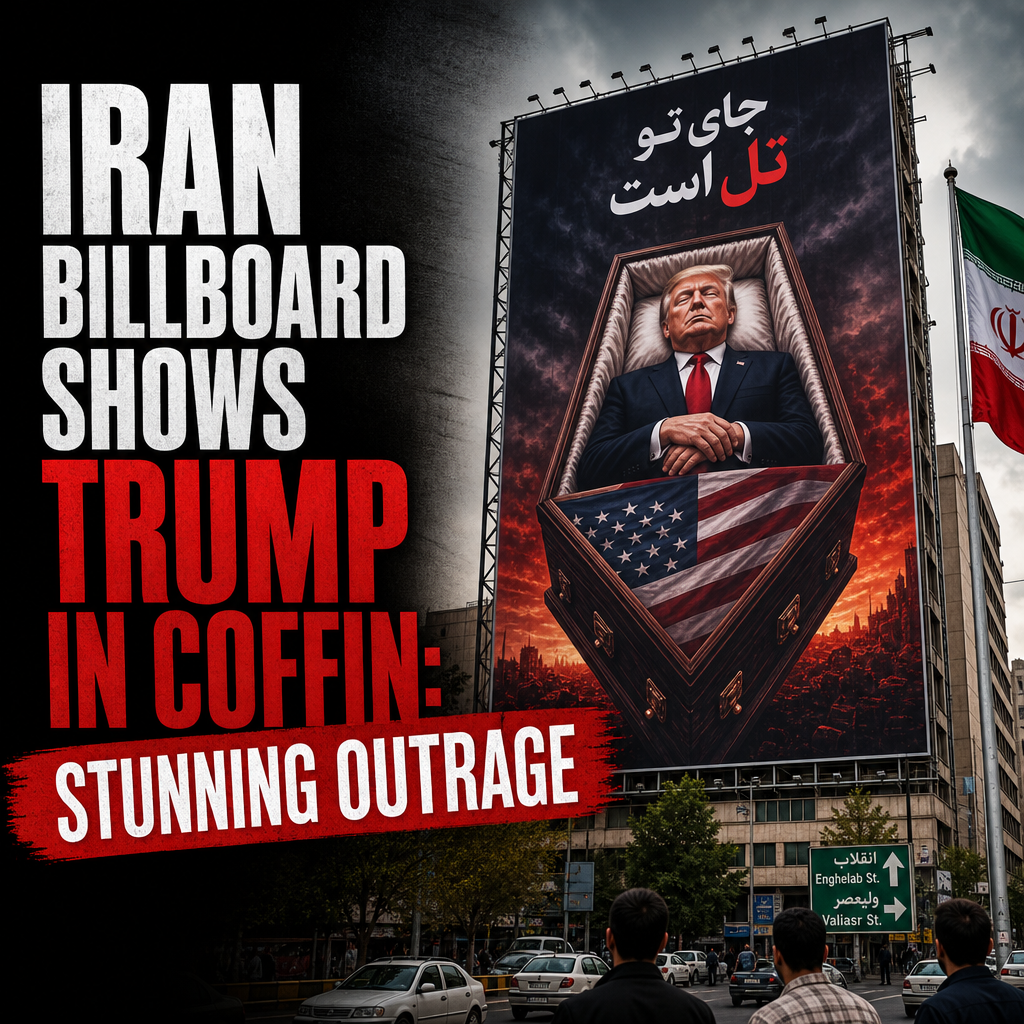
Iran billboard imagery is once again underscoring how visual propaganda can inflame an already volatile geopolitical climate, and the latest case — a giant display showing Donald Trump in a coffin — has triggered outrage far beyond Iran’s borders.
At first glance, the billboard is shocking because it is meant to be. But the deeper story is less about a single image and more about what it reveals: the persistence of hostility between Iran and the United States, the use of symbolism as political messaging, and the way regional actors continue to weaponize spectacle in a conflict defined as much by perception as by policy.



What the Iran billboard is trying to say
The message behind a billboard of Trump in a coffin is hardly subtle. It is designed to provoke, signal defiance, and communicate contempt for a former U.S. president who remains deeply polarizing in the Middle East. Whether viewed as a political taunt, a warning, or an act of symbolic vengeance, the image is clearly meant to dominate attention.
That matters because these kinds of displays do not exist in a vacuum. In the region’s political culture, public imagery often serves as a stand-in for formal statements. It can be used to rally supporters at home, send a message to adversaries abroad, or test the boundaries of what can be said without directly escalating military tensions.




From a hardline Iranian perspective, the billboard may be intended to celebrate resistance against a leader associated with the 2020 killing of Qassem Soleimani, the Iranian commander whose death remains a powerful rallying point in the country. From that angle, the image is less a random insult and more a continuation of a long-running narrative of revenge, martyrdom, and anti-American symbolism.
But for outsiders, the reaction is likely to be very different. Many will see the display as needlessly inflammatory, dehumanizing, and reckless at a moment when the region is already burdened by wars, proxy conflicts, and unstable diplomacy.
Why the symbolism matters
A coffin image does more than insult a political figure. It suggests finality, triumph, and the erasure of an enemy. That makes it especially potent, and especially dangerous.
It also raises a broader question: do these symbols actually strengthen the position of those who use them, or do they simply deepen isolation?
There are two competing interpretations:
– Supporters of the display may see it as psychological warfare — a way to project strength and show that threats from Washington do not intimidate Tehran.
– Critics will see it as a cheap substitute for real policy, one that hardens public sentiment while doing nothing to improve security or diplomacy.
Both interpretations are plausible, and both reveal something important: the billboard is not really about Trump alone. It is about signaling. It is about identity. And it is about the enduring need of political movements to create enemies that can be shown, named, and symbolically defeated.
Reactions from Al Jazeera, RT, and Sky News suggest a split in framing
The three outlets tied to this story point toward distinct ways of understanding the event.
Al Jazeera’s coverage, which often emphasizes regional context, tends to place provocative Iranian messaging within the wider dynamics of Middle Eastern conflict, rather than treating it as an isolated spectacle. That approach invites readers to consider the billboard as part of a broader political language used by state and non-state actors alike.
RT, by contrast, often highlights anti-Western symbolism and the dramatic visual power of such gestures. In that frame, the billboard can be read less as an anomaly and more as a blunt expression of resistance to U.S. power and its political figures. That perspective may resonate with audiences skeptical of Washington, but it can also flatten the ethical questions into a simplistic us-versus-them narrative.
Sky News, on the other hand, is likely to foreground the outrage factor: the image’s offensiveness, its potential to inflame tensions, and the diplomatic awkwardness it creates for any international response. That framing is important because it reminds audiences that symbolic acts can carry real-world consequences, especially when they feed existing mistrust.
Taken together, the contrast is revealing. One outlet may see context, another defiance, and another outrage. The truth likely contains all three.
Why this kind of stunt keeps happening
Political billboard warfare is not new. Governments and aligned groups have long used giant posters, murals, and public projections to transform ordinary cityscapes into ideological battlegrounds. The technique is effective because it is simple: it bypasses debate and speaks directly to emotion.
In this case, the image of Trump in a coffin appears designed to do several things at once:
– reinforce internal narratives of resistance
– provoke U.S. political backlash
– remind regional audiences that Iran remains willing to confront American power symbolically
– generate international coverage at minimal cost
That last point may be the most important. In the age of viral news, outrage itself is a form of currency. A billboard like this can travel farther online than any official speech, making it an inexpensive way to command attention.
But attention is not the same as influence. If the goal is to project strength, the display may succeed. If the goal is to improve Iran’s strategic position, the answer is less clear. Such gestures can energize supporters, but they also reinforce fears about Iranian hostility and undermine claims that Tehran is seeking de-escalation or diplomatic engagement.
A fair reading of the outrage
The outrage is understandable. Depicting a living political figure in a coffin is deeply provocative, and many will find it morally ugly regardless of their views on Trump or on U.S. foreign policy. Even people who oppose Washington’s interventions may recoil at imagery that seems to celebrate death rather than argue a position.
At the same time, outrage alone can obscure context. Iran’s political messaging is often shaped by a long history of sanctions, coercive pressure, and military confrontation. To understand the billboard, one has to recognize that it is not simply an isolated insult — it is part of an ongoing struggle over memory, power, and legitimacy.
The most responsible conclusion is that the billboard is both propaganda and symptom: propaganda in the sense that it is deliberately theatrical, and symptom in the sense that it reflects a relationship between Iran and the United States that remains poisonous, unresolved, and highly susceptible to symbolic escalation.
In other words, the image is shocking — but sadly, not surprising.